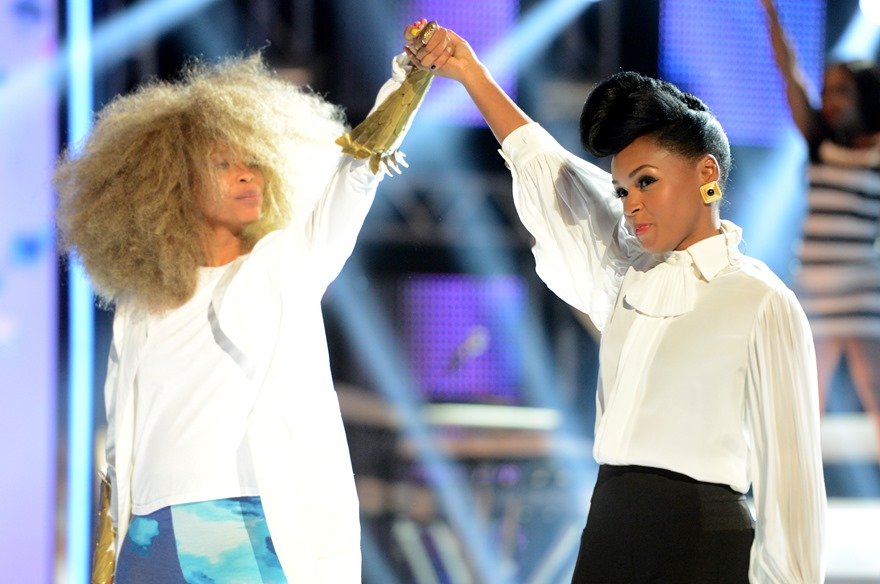
Though relatively new to the soul music scene, Janelle Monae’s spitfire spunky-sweet take on a jazz, soul, rockabilly, funk fusion was well received by the crowd. She bounced and danced across the stage, barely losing a breath as she ripped through “Come Alive,” “Dance or Die,” and “Faster” from her recently released The ArchAndroid. Balancing beautiful, robust vocals, boundless energy, an engaging sense of drama, and what seemed like an innate ability to entertain, Monae’s stage show matched the melodious mania of her album.
She kept it simple and classy in one of her trademark black and white ensembles, this time rocking a fitted white puffed-sleeve top and tailored-to-a-tee tuxedo pants, cutting a fine figure as she ducked and jabbed alongside a screen projecting black and white footage of Ali during "Cold War," her enthusiastic mimicry adding a bit of whimsy to the urgent question of the song's chorus ("Do you know what you're fighting for?"). Her fits also lent a classic feel to her performance of “Smile,” the acoustic accompaniment giving her strong soprano ample room to swoop and sway around the uplifting lyrics. And just to make sure the folks in the back could see her, and perhaps to demonstrate her impeccable posture, she performed the song standing stock still atop a bar stool.
As she zoomed through songs, the crowd slowly began to simmer, and by the time she reached her funky, feel-good first single “Tightrope,” they had boiled over, people propelled to their feet by the infectious rhythm and funny dance. As opening acts go, Monae got the crowd as wide open as the Grand Canyon, the room buzzing like a hive of bees for several minutes after she left the stage.
While Monae’s opener was a master class in youthful rebellion, Erykah Badu’s set was a study of wizened revolution — or as her “controversial” "Window Seat" video suggests, evolution. After the show, Boston Badu fans crowded around the product tables, clamoring for a turquoise-soaked shirt with “EVOLVING” emblazoned across the back, or a yellow baby tee with Erykah’s signature African ankh symbol. Badu came casual too, draped at first in a tan, red, and yellow striped cape and a dramatic black top hat before shedding those effects for simple sweat pants and a tight tee.
Her performance that night was similarly stripped down, and her willingness to bare all about her life, loves, and emotions proved more interesting than watching her get naked in the streets of Dallas. Even before the encore, the self-anointed “analog girl in a digital world" owned the stage with her subtle blend of confidence and vulnerability, and her innovative mix of old and new soul. She spilled on the struggles and triumphs of her life as an entertainer during a medley that merged her verses on OutKast’s “Liberation,” (from 1998’s Aquemini) and “Humble Mumble” (2000’s Stankonia) with “That Hump” (2009’s New Amerykah Part 1: 4th World War). Other times, she sang of the ups and downs of her love life, conquering “Out My Mind (Just in Time)" early in her set before getting into "Tyrone" and "No Love," which were as witty, scathing, and moody as the first time you heard them more than a decade ago.
She performed plenty of old and new favorites. Plenty of heads nodded to her revolutionary rap anthem “Hip Hop,” swayed along to the sensual, swaying soul sample in “Umm Hmm,” and sung along to “Window Seat." When she took it back to the Baduizm days with “Appletree,” “On & On,” “Otherside of the Game,” and “Next Lifetime,” you were reminded of why you love Badu in the first place — the jazzy hip hop grooves, the bluesy, loverlorn ballads, the complex simplicity of her lyrics and most importantly, the winsome way she keeps it oh so real. She may be a soul music goddess, but on stage, she's decidedly down to earth.